
Arrays and Equal Groups: The Picture Behind Multiplication
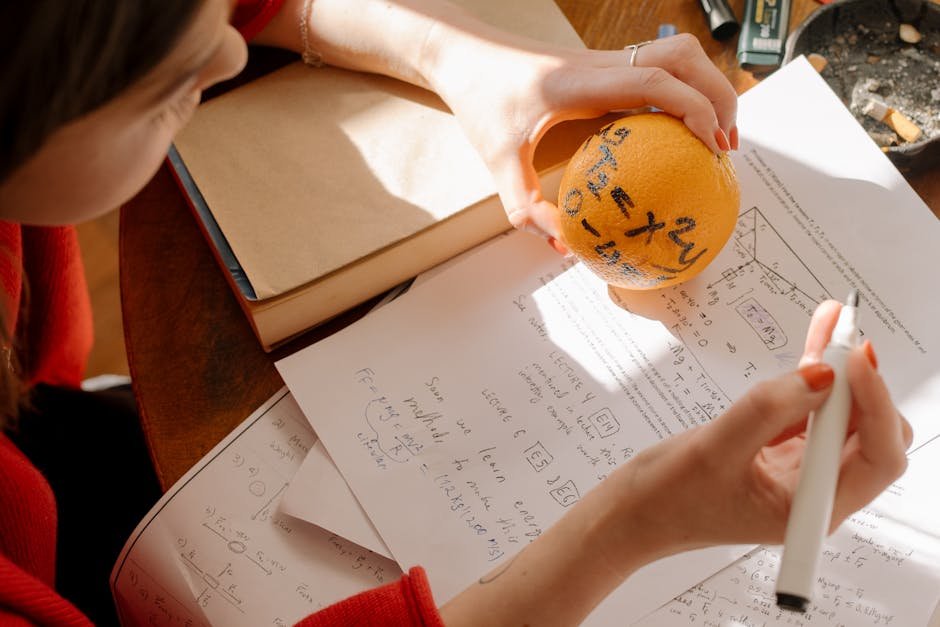
Look at a 3rd grader's math homework and you will often see circles with dots inside, or neat rows of stars. Those drawings are not decoration. They are equal groups and arrays, the two pictures the standards use to show what multiplication means.
Knowing what they are, how they grow from grade to grade, and how to draw them with your child makes homework easier to follow and gives every fact a picture to lean on.
Two Pictures of the Same Idea
An equal-groups picture shows separate groups with the same number in each: four circles with three dots in each circle. An array lines the same objects up in rows and columns: four rows of three dots. Both show 4 × 3 = 12.
The difference is mostly in how they look. Equal groups match stories about bags, boxes, and plates. Arrays match things that come in rows: egg cartons, muffin tins, chairs in an auditorium, windows on a building.
Arrays have one extra advantage. Turn an array on its side and the rows become columns. Four rows of three become three rows of four, with the same 12 dots. That makes it easy to see why 4 × 3 and 3 × 4 have the same answer, a property 3rd graders are expected to use.
In the order the standards use, the first number usually tells how many groups or rows, and the second tells how many in each. So 3 × 5 is 3 groups of 5, or 3 rows of 5. Some teachers phrase rows and columns a little differently, so follow your child's class if the homework does it another way.
How the Picture Grows From Grade to Grade
2nd Grade: Adding Rows
Arrays start before multiplication does. In 2nd grade, children find the total in an array of up to 5 rows and 5 columns by adding, and write it as a sum of equal addends. An array of 4 rows of 3 becomes 3 + 3 + 3 + 3 = 12.
That repeated addition is the bridge. When multiplication arrives, a child who already sees 3 + 3 + 3 + 3 in the rows can learn that 4 × 3 is a shorter way to write the same thing.
3rd Grade: Groups, Rows, and Area
Third grade is where equal groups and arrays do the most work. The standards treat a product as a number of equal groups, and ask students to solve word problems with equal groups and arrays, using drawings when they help.
Area arrives the same year. Students cover a rectangle with square tiles and count them, then see that the count matches multiplying the two side lengths. A rectangle 4 tiles wide and 6 tiles long holds 24 tiles, and 4 × 6 = 24. The array of tiles is the area.
The standards also ask students to split a rectangle into two parts to multiply. A rectangle 8 by 7 can be cut into an 8-by-5 part and an 8-by-2 part: 40 + 16 = 56. That is the same 8 × 7, shown as two smaller arrays side by side.
4th and 5th Grade: Bigger Rectangles
Once single-digit facts are in place, the array grows into an area model for larger numbers. To multiply 6 × 14, draw a 6-by-14 rectangle and split it into 6 by 10 and 6 by 4: 60 + 24 = 84. The same picture handles 23 × 14 later on.
In 5th grade, the standards ask students to explain division with rectangular arrays or area models as well. To find 96 ÷ 4, a student can think of a rectangle with an area of 96 and one side of 4, and work out the missing side: 24.
Drawing Them at Home
When your child is stuck on a fact, ask for a drawing before the answer. For 6 × 4, draw six circles and put four dots in each, or draw six rows of four dots. Then count by rows: 4, 8, 12, 16, 20, 24.
Speed matters more than art here. Dots or small x's are better than detailed apples. The goal is to see the structure, not to make art, and a drawing that takes five minutes defeats the point.
Grid paper makes arrays easy. Color in 3 rows of 7 squares, count them, and write 3 × 7 = 21 underneath. Then turn the paper and read it as 7 rows of 3. The same fact, two ways of seeing it.
Real objects work too. Muffin tins are arrays: a tin with 3 rows of 4 cups holds 12 muffins. An egg carton is 2 rows of 6. Rows of chairs, panes in a window, and squares on a chessboard are all arrays waiting to be counted.
From Pictures to Quick Recall
Pictures are how a fact starts, not where it should stay. Counting dots for 7 × 8 every time is slow, and by the end of 3rd grade the standards expect single-digit facts to be known from memory.
The picture's job is to make the fact mean something. Once your child knows that 6 × 4 is six groups of four, regular practice can make the answer quick. If a fact is forgotten later, the picture is still there to rebuild it.
A good sequence is to draw a few facts from a table, say them aloud, and then practice the table in order and mixed. The 3 times table is a good place to start with drawings, since threes are small enough to draw quickly. Later, the 6 times table page works well for practicing facts your child has already drawn.
Common Mix-Ups With Arrays
Children sometimes count the dots one by one instead of counting by rows. That works for small arrays but takes forever for larger ones. Encourage counting by rows, then by facts once those are known.
Another mix-up is uneven groups. A drawing for 4 × 3 with three dots in one circle and four in another is not equal groups anymore. A quick check that every group has the same number, before counting, catches it.
Some children also confuse which number goes with the rows. That matters less than it seems, because the answer is the same either way. Still, matching the class convention helps when the teacher grades drawings, so check a homework example if you are unsure.