
Log In to Earn Your Certificate!
Got a class password from your teacher? Log in, click your name, and your stars are saved for next time.
Class Password 🔑
Free Times Tables Practice for Home and School
Class Password
Kids log in with one class password from their teacher. No email address needed.
Track Progress
Teachers see every student's stars and certificates at a glance. Parents can follow their own child the same way.
Certificate
Five stars on a table earns a printable certificate. Then kids can go for bronze, silver, and gold.
At Your Own Pace
Stars 1 to 4 have no timer, so kids can think each problem through and try a round again later.
How Kids Earn Stars and Certificates
Every table has five stars, and each star asks a little more. Star 1 walks through the table in order, and a wrong answer brings up a hint that writes the problem as an addition. Star 2 mixes the same facts up and takes the hint away, star 3 turns the facts into word problems, and star 4 is multiple choice in mixed order. Star 5 is the final check: twenty questions in three minutes, all correct, for a printable certificate of that table. After that come the three bigger certificates. Bronze covers the 1s through 5s plus the 10s. Silver and gold cover everything up to 10, and gold allows less time.

When Do Kids Learn Their Times Tables?
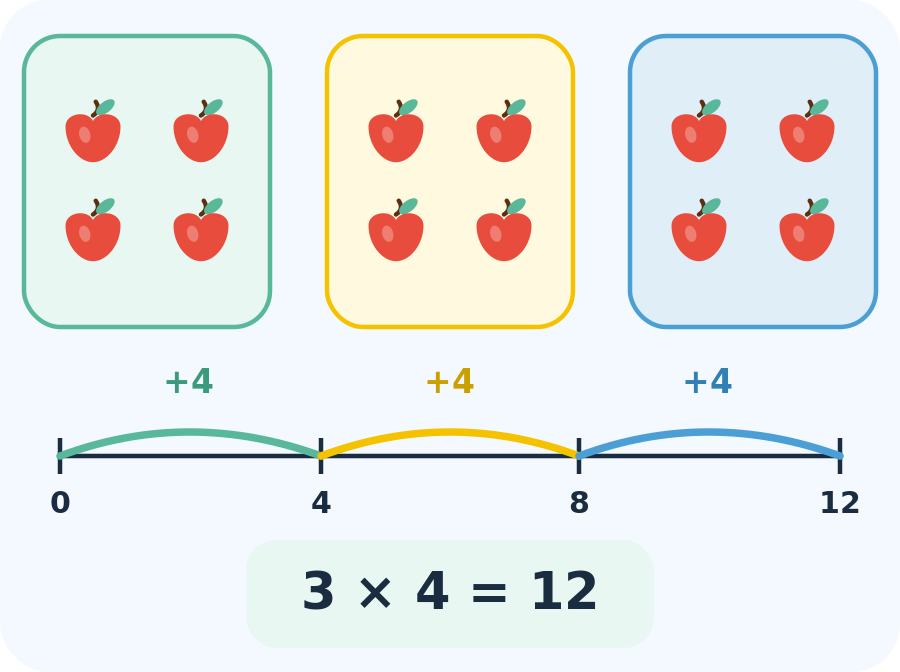
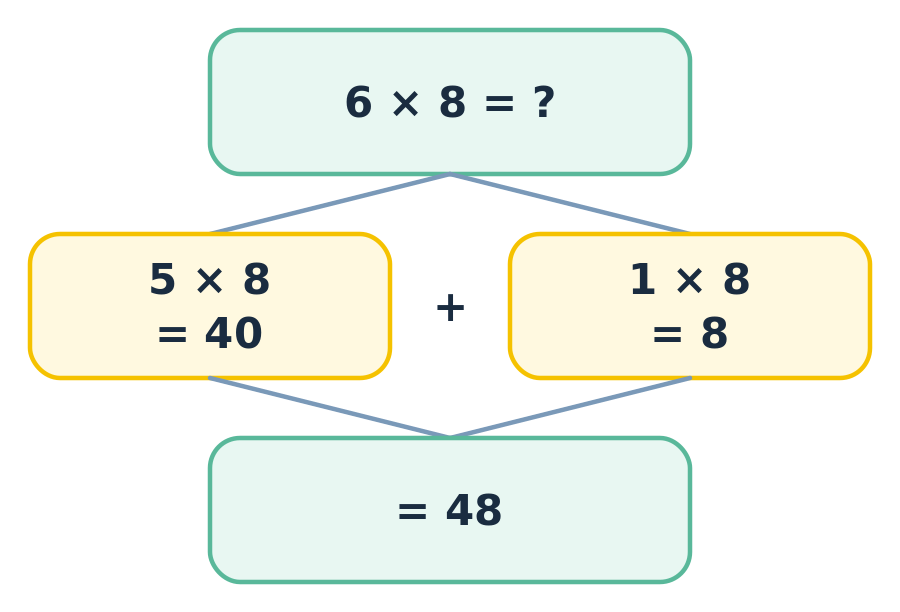
In most states, multiplication really gets going in 3rd grade. It starts with meaning: 5 × 7 means 5 groups of 7. Kids draw equal groups, build arrays with rows of counters, and skip count long before anyone asks for speed. Then come the strategies. If you know 3 × 4, you also know 4 × 3, and 6 × 7 is just 5 × 7 plus one more 7. By the end of 3rd grade, the Common Core standard 3.OA.C.7 expects kids to know all products of two one-digit numbers from memory. Texas, with its own standards, asks for the same up to 10 × 10. Some programs check this with a short timed quiz, such as 30 problems in 3 minutes. Many classes begin with the 2s, 5s, and 10s, and so does the Bronze Certificate.
Why Quick Recall Pays Off in 4th Grade
In 4th grade the facts stop being the lesson and become the tool. Students multiply numbers of up to four digits by a one-digit number, and two two-digit numbers by each other. They divide with remainders, check division with multiplication, list all the factor pairs of numbers up to 100, and solve comparison problems like "a rope is 6 times as long as a ribbon." A child who still counts on fingers for 7 × 8 easily loses track halfway through 48 × 7, because working memory is busy with the counting. So a few minutes of practice a day still pays off, even for tables a child already knows.

Multiplication Facts in 5th Grade and Beyond
By 5th grade, teachers expect the facts to come without thinking. Students multiply multi-digit numbers with the standard algorithm and divide by two-digit numbers, which means long division with many small multiplication steps along the way. Fractions depend on the facts too: to add 2/3 and 5/4, kids rename both as twelfths, because twelve is a multiple of both denominators. Multiplying decimals starts from the same facts as well. One slow or wrong fact can hide inside a long problem, and then the whole answer is off. The 11s and 12s are not part of Common Core, but many schools and families practice them anyway, so you'll find both tables here as well.