
Sidewalk Chalk Arrays: Drawing Multiplication Outside
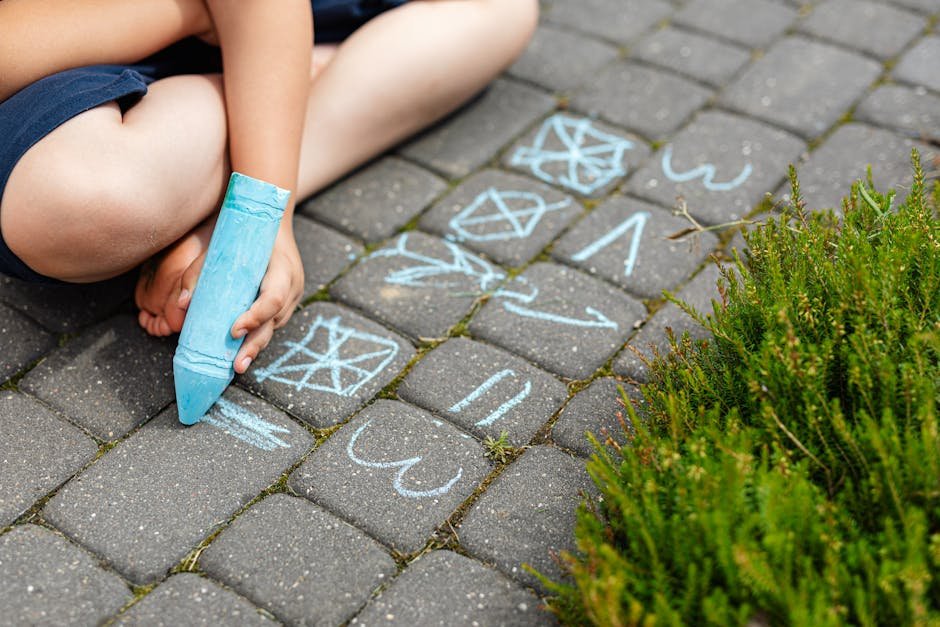
A box of sidewalk chalk and a stretch of driveway can do something a worksheet cannot: let a child draw multiplication big enough to walk around. Rows of dots, rectangles of squares, and whole floor plans fit on the pavement.
The activities here are for kids in 2nd to 4th grade, sorted by grade, and each one comes with a worked example you can copy. Everything is drawn; no jumping or running games, just chalk and a little space.
Why Chalk Works for Multiplication
Much of elementary multiplication is about pictures. In 2nd grade, the standards ask kids to find the total of objects arranged in rows and columns.
In 3rd grade, they learn that a product like 5 × 7 means 5 groups of 7, and that the area of a rectangle comes from multiplying its sides.
All of those ideas are easier to see when they are large. A 4 by 6 array on paper fits under a thumb. On the sidewalk, each dot can be the size of a fist, and a child can count by walking along a row.
Many driveways and patios also come with a grid built in. Paving stones, concrete squares, and tiles make ready-made unit squares. The 3rd grade standards even mention measuring area with "improvised units," and a paving stone is exactly that.
2nd Grade: Rows and Columns
Second graders are not yet expected to multiply, but they are building the idea. The standards ask them to add up arrays of up to 5 rows and 5 columns and to write the total as a sum of equal numbers.
Dot Arrays
Draw 3 rows of 4 big dots. Have your child count the dots in each row, then write the addition next to the drawing: 4 + 4 + 4 = 12. Then draw a line under each row and count again by rows: 4, 8, 12.
Next, ask your child to draw the same 12 dots in a different array, such as 2 rows of 6 or 4 rows of 3. Each new array gets its own addition sentence. Seeing several shapes with the same total is an early look at a big idea in 3rd grade.
Even or Odd Lines
Have your child draw a number of dots, say 9, and then pair them up with chalk lines. If every dot has a partner, the number is even.
With 9, one dot is left alone, so 9 is odd. Try a few numbers up to 20 and keep a list of which ones came out even.
3rd Grade: Rectangles and Facts
In 3rd grade, the arrays turn into multiplication facts, and the rectangles turn into area. Chalk handles both well.
Fact Rectangles
Pick a fact your child is working on, such as 6 × 4. Draw 6 rows of 4 squares, using the paving stones if you have them or a chalk grid if you do not. Your child writes 6 × 4 = 24 inside the rectangle.
Then step around to the side. From there, the same rectangle looks like 4 rows of 6. Write 4 × 6 = 24 on that side. Walking around the rectangle shows that switching the two numbers leaves the total alone.
Split the Rectangle
Draw a rectangle of 7 rows by 8 columns. Many kids find 7 × 8 hard to remember. Now draw a chalk line down the rectangle after the fifth column.
On the left is 7 × 5 = 35, and on the right is 7 × 3 = 21. Together, 35 + 21 = 56, so 7 × 8 = 56.
This is the same idea that shows up in 3rd grade homework as the distributive property, and the 3rd grade standards show it the same way, with area models.
Your child can try splitting the rectangle in other places too. After the second column, 7 × 2 = 14 and 7 × 6 = 42, which also adds up to 56.
Area in Paving Stones
Get your child to chalk the outline of a rectangle that covers 3 rows of 5 paving stones. How many stones are inside?
Count them first, then check with 3 × 5 = 15. Then ask: can you outline a different rectangle with 15 stones? A single row of 15 works, and so does 5 by 3.
4th Grade: Area, Perimeter, and Floor Plans
By 4th grade, the standards expect kids to apply the area and perimeter formulas for rectangles in real problems. The sidewalk is a good place to make those problems real.
Same Area, Different Shape
Give your child a target area, such as 24 square feet, and ask for every rectangle with that area made of whole squares: 1 by 24, 2 by 12, 3 by 8, and 4 by 6.
Draw a few of them. Then measure the perimeter of each. The 4 by 6 rectangle has a perimeter of 20 feet, while the 1 by 24 strip has 50.
Talking about why the long, thin rectangle has such a large edge is good math talk. It also helps kids see that area and perimeter measure different things.
A Chalk Floor Plan
Let your child design a room, a treehouse, or a dream bedroom on the driveway. Use one paving stone or one chalk square for each square foot. A bed might take 3 by 6 squares, or 18 square feet.
A rug might be 4 by 5, or 20 square feet. Ask how much floor is left if the whole room is 10 by 12, which is 120 square feet. With the bed and the rug, 120 − 18 − 20 leaves 82 square feet.
Floor plans are open-ended, so children can make them as simple or detailed as they like. Every piece of furniture adds a new multiplication fact.
Bringing It Back Inside
Chalk drawings wash away with the next rain, so take a photo of the best ones before they disappear. A picture of the 7 by 8 rectangle with its chalk line can go on the fridge as a reminder.
When the facts from the sidewalk start to stick, check them without the drawing. A short round on the 6 times table page, or whichever table your child drew that day, shows which facts have moved from picture to memory.
And if you want more ideas for the yard, the post on backyard multiplication activities uses pinecones, flower pots, and rocks.