
Multiplication Hopscotch: 5 Variations
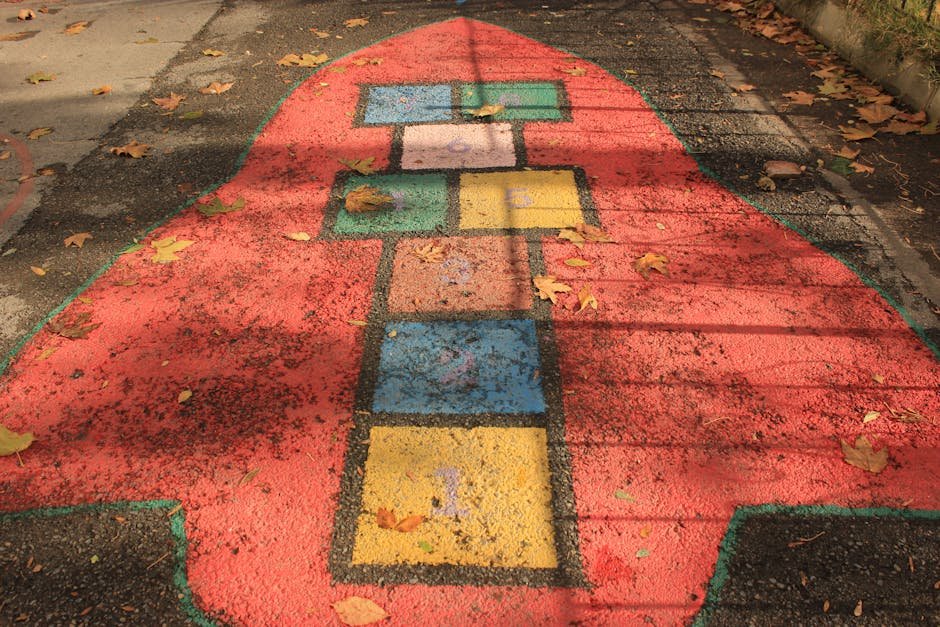
A hopscotch court is really a number line you can jump on. Chalk it on the driveway or tape it to a classroom floor, and the old playground game becomes multiplication practice that gets kids off their chairs.
The five versions in this article range from a simple counting hop for younger kids to a mixed-up court for kids who already know most of their facts.
Setting Up the Court
A traditional court is a row of numbered boxes, usually up to 10, where single boxes alternate with pairs of boxes side by side. Players toss a marker into box 1, hop over that box, land on one foot in the single boxes and with a foot in each box of a pair, turn around at the top, and pick up the marker on the way back.
Stepping on a line or missing a box ends the turn. For the math versions, keep those rules loose and number the squares 1 to 10. Sidewalk chalk works outside; painter's tape or masking tape works on a classroom or hallway floor and peels off cleanly at the end of the day. You also need a marker to toss, such as a beanbag, a flat stone, or a bottle cap.
Keep a short list of facts nearby for the grown-up or the partner who checks answers. The jumper should be thinking about the math, not about whether anyone is keeping track.
Five Ways to Play
1. The Counting Hop
Pick one table, such as the 4s. Your child hops from square to square and says one multiple per square: 4, 8, 12, 16, all the way to 40 on square 10.
At the top, they turn around and count back down: 40, 36, 32. Counting backward is harder than it sounds, and it shows quickly where the gaps are.
2. Toss and Multiply
Choose a table for the round. Your child tosses the marker, hops to it, and says the fact for that square. With the 3s, a toss onto 6 means 6 × 3 = 18. Then they pick up the marker and hop back.
A wrong answer is no big deal: count up by threes together and toss again.
3. The Answer Court
Instead of 1 to 10, write the answers of one table in the squares, in a jumbled order. For the 6s, that is 6, 12, 18 and so on up to 60. A partner calls out a fact, like 7 × 6, and the jumper hops to the square with 42.
This version makes kids hold the fact in their head while they find the square.
4. The Missing Number
Keep the squares numbered 1 to 10. A partner says a fact with a gap, such as "something times 8 is 56," and the jumper has to land on 7.
Kids who can multiply but have not thought much about division often find this one tricky at first, and that makes it worth playing.
5. The Mixed-Up Court
Chalk the numbers 1 to 10 in a scrambled order, so the jumper cannot simply go up the line. Call out a table and have your child hop the squares in the order they appear, saying the fact for each one.
On a court that reads 7, 2, 9, 4, the 5s become 35, 10, 45, 20. This is mixed practice in disguise.
Making It Fit Your Kids
Moving while practicing will not make facts stick by magic. A Kansas program that built physical activity into regular lessons found better test scores in its first study, but a larger three-year follow-up in 2nd and 3rd grade classrooms found no effect on math, good or bad. What movement does offer is a break from sitting and a reason for a restless kid to say twenty facts in a row.
Younger kids in 2nd grade can stick to the counting hop with the 2s, 5s, and 10s. Third and fourth graders who are working on the 6s through 9s get more out of the answer court and the mixed-up court. Change the table, not the game, and it stays fresh for weeks.
In a classroom, set up two or three courts and play in groups of three: one jumper, one caller, one checker. Rotate after every turn so nobody waits long. Skip races between teams if some students are still slow with their facts, because a race puts the spotlight on exactly the kids who need calm practice.
Hopscotch is a good warm-up, but it covers only a few facts per turn. Afterward, a short round of mixed facts on the 6 times table page or whichever table you hopped shows whether the facts stuck once your child is sitting still again.