
Times Tables at the Grocery Store: Real-Life Math
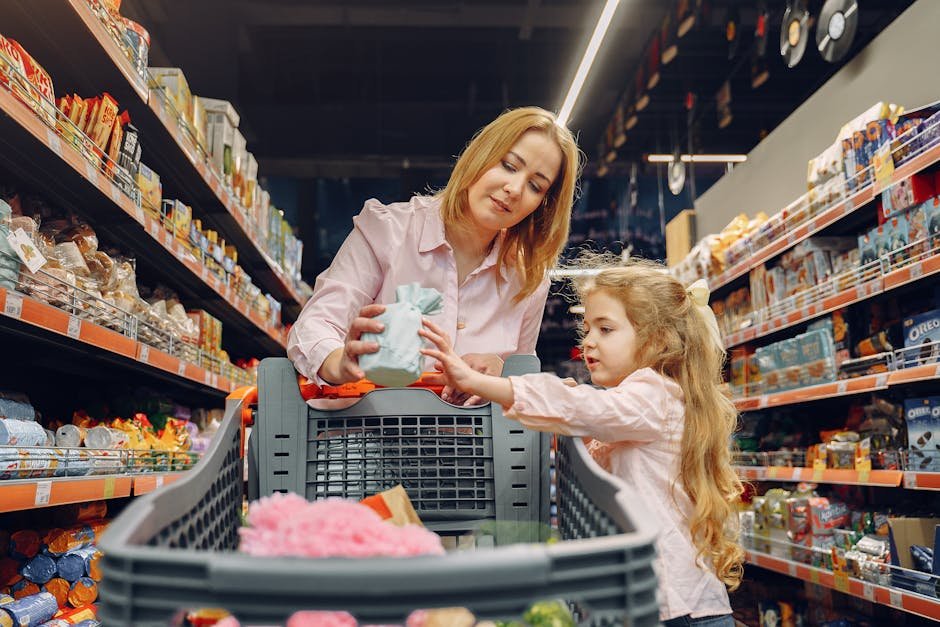
A weekly grocery run is full of equal groups. Eggs come by the dozen, yogurt comes in packs, and the shelf tags are covered in prices. Most of it goes by without anyone noticing, but with a little attention, the store becomes a place to practice multiplication with real stakes.
Below we walk through one trip, from the list at home to the checkout line, with questions you can ask along the way. None of it needs a worksheet. Pick the questions that fit your child's grade and patience.
Before You Leave the House
The math starts with the list. Ask your child how much of something the family needs for the week. If four people each eat one yogurt on school days, that is 4 × 5 = 20 yogurts. If yogurt comes in packs of 4, how many packs is that?
Lunches work the same way. Three kids who each take two snacks a day for five days need 3 × 2 × 5 = 30 snacks. Younger kids can do it in two steps: first 3 × 2 = 6 snacks a day, then 6 × 5 = 30 for the week.
Let your child write the numbers next to the items on the list. When you get to the store, they already know what they are looking for, and they get to check whether the plan holds up against what is on the shelf.
Packs, Cartons, and Cases
Packaged food is where equal groups are easiest to see, because almost everything comes in a package with a fixed count. A carton of eggs holds 12. Two cartons hold 24, and your child can check by counting the rows: 2 rows of 6 in each carton.
Ask your child to read the count on a package before you put it in the cart. A box of granola bars might say 8. If you buy 3 boxes, how many bars is that? The answer, 24, is easy to check at home by lining them up.
Some questions work in reverse. If you need 30 juice boxes for a class party and they come in packs of 10, how many packs do you need? Kids see quickly that 3 packs do the job.
If they come in packs of 8, the question gets more interesting. Three packs give only 24, so you need a fourth, and 4 packs give 32, two more than the party needs.
Drinks and paper goods are good for bigger numbers. Two cases of 24 water bottles make 48 bottles, and three packs of 6 paper towel rolls make 18 rolls. Older kids can do these in their heads, and younger kids can count by 6s or 8s out loud.
Then there is the classic cookout puzzle. Hot dogs usually come 10 to a pack, and buns 8 to a bag. How many packs of each do you need so nothing is left over? Counting by 10s and by 8s, your child finds 40: 4 packs of hot dogs and 5 bags of buns.
In the Produce Section
Fruit and vegetables bring in prices. Some items are sold by the piece, which keeps the math simple. If avocados cost $2 each and you need 4, that is 4 × $2 = $8. If limes are 3 for $1, how much do 9 limes cost? Your child can count by 3s to find $3.
Other items are sold by the pound, and the scale in the produce aisle is a fun tool. Let your child weigh a bag of apples and read the number. With older kids, you can estimate: if apples cost $2 a pound and the bag weighs about 3 pounds, the bag costs about $6.
Keep the produce questions short. This part of the store is crowded, and your child is juggling bags. One or two questions here are plenty, and you can save the rest for a calmer aisle.
Which Deal Is Better?
Stores love offers like "2 for $5," and they are perfect for multiplication. If one box of crackers costs $3 by itself, two boxes would be 2 × $3 = $6.
The deal costs $5, so it saves $1. Kids enjoy catching the store being generous or not.
Sometimes the deal is not a deal. If a single bottle costs $2 and the offer is "3 for $7," then 3 single bottles would cost $6. Buying three at the offer price costs a dollar more. Ask your child to check every "for" sign you pass, and see how many are really worth it.
Many shelf tags also show a unit price, such as the cost per ounce or per count, printed in a small box near the regular price. Fourth and fifth graders can use it to compare a small box and a big box of the same cereal. Not every state requires these labels, so you may not see them in every store.
The bigger package is not always the better deal. On one recent check at a national chain, a dozen eggs cost $1.49, about 12 cents an egg, while 18 eggs cost $2.49, about 14 cents an egg. Ask your child to work out which carton to buy.
While You Wait in Line
The checkout line is a good spot for estimating. Before the cashier starts, ask your child to guess the total. A quick way is to count items and give each one a rough price: 12 items at about $4 each is about $48. Then compare with the real total.
The guess will be off, and that is fine. What matters is that your child gets close, and gets a feel for how quickly small prices add up.
If you use a cart, your child can also group the items to make counting easier: 4 cans in a row, 3 rows, 12 cans. That is the same idea as an array on a worksheet, and seeing it with real cans makes it stick.
At the register, let an older child watch the screen and keep a running guess. When the receipt prints, look together at one line where you bought several of the same item. Seeing "3 @ $1.50" and a line total of $4.50 shows multiplication doing a real job.
Matching the Questions to Your Child
A 2nd grader is still building the idea of equal groups. Stick to counting packs, rows of eggs, and skip counting by 2s, 5s, and 10s. Questions like "How many eggs in two cartons?" are just right.
In 3rd grade, kids are learning the facts themselves, so ask questions that use a single fact: 4 packs of 6, 3 boxes of 8. If your child is working on one table right now, steer toward it. If they are practicing the 6 times table, egg cartons and six-packs are your best friends.
By 4th and 5th grade, bring in bigger numbers and money: weekly totals, comparing deals, the unit price on the shelf tag. Ask for an estimate first and an exact answer second, so your child gets in the habit of checking whether an answer makes sense.
Whatever the grade, keep the tone light. A few good questions per trip is enough. If your child is tired or the store is busy, skip the math that day. The point is to show that multiplication is useful, and that works best when the trip still feels like a trip.