Veerle Dielen · Elementary teacher · June 19, 2026 · Real-World Math
Multiplication in Cooking: Doubling, Halving, and Scaling Recipes
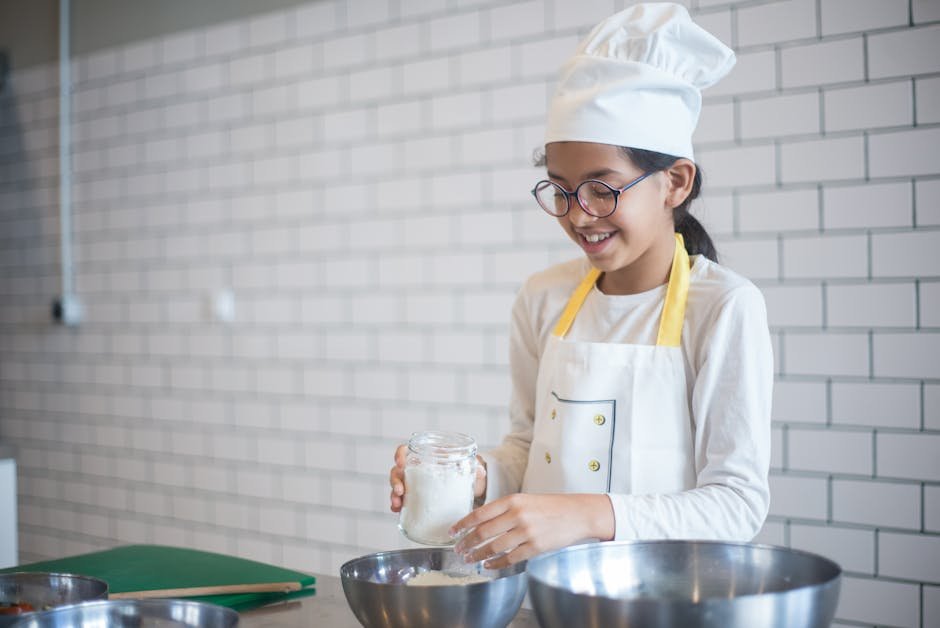
The kitchen is arguably one of the most effective math classrooms available to parents. Every recipe presents a small math problem, cleverly disguised as a meal. Whether you're doubling a recipe to feed a crowd, halving it for smaller portions, or scaling it from a family-of-four recipe to accommodate six, cooking is all about multiplication. Engaging your child in cooking just a few times a month can turn meal preparation into an enjoyable math practice session.This guide delves into the mathematics embedded in cooking, offers tips on discussing it with your child, walks through real recipes, and explores how to transform your kitchen into a long-term math learning environment.
Why Cooking Is Such Good Math Practice
Cooking is an exceptional tool for math practice for several reasons:First, the math has a tangible purpose. Instead of solving abstract problems from a worksheet, your child is determining how many eggs are needed for dinner. This connection gives math meaning and urgency, which is often missing in abstract problem-solving scenarios.Second, the math is visible and tactile. When you double a recipe, you can see the bowls filling up, the flour accumulating, and the eggs multiplying. Abstract numbers become concrete quantities that children can see and touch, a concept particularly beneficial for visual or kinesthetic learners.Third, cooking feels like a collaborative effort. When math is integrated into cooking with a parent, it becomes a part of the shared activity rather than a separate chore. Children who might resist a 10-minute math worksheet often eagerly engage in an hour of math while baking cookies.
Doubling Recipes
One of the most common forms of kitchen multiplication is doubling. If a recipe serves four but you need to serve eight, every ingredient needs to be multiplied by two.
Doubling Simple Numbers
Many ingredient amounts are straightforward to double:
- 2 cups of flour become 4 cups
- 1 teaspoon of salt becomes 2 teaspoons
- 3 eggs become 6 eggs
- 1/2 cup of sugar becomes 1 cup
- 1/4 teaspoon of baking soda becomes 1/2 teaspoon
This process involves applying the 2 times table to both fractions and whole numbers. Even young children can follow along and participate by doing the math out loud as you work through the recipe together.
Doubling Trickier Amounts
Some ingredient amounts are trickier to double:
- 3/4 cup doubled equals 1 1/2 cups (or 1.5 cups)
- 2/3 cup doubled equals 4/3 cups, which simplifies to 1 1/3 cups
- 1 1/2 cups doubled equals 3 cups
- 1/8 teaspoon doubled equals 1/4 teaspoon
These scenarios require fraction multiplication. For older children (4th grade and up), this provides excellent practice. For younger children, work through the math together and explain the process.
Halving Recipes
Conversely, sometimes a recipe yields too much, and you need to halve it.
Halving Simple Amounts
For straightforward quantities, halving is simply dividing by 2 (or multiplying by 1/2):
- 4 cups of flour become 2 cups
- 6 eggs become 3 eggs
- 1 cup of sugar becomes 1/2 cup
Halving Tricky Amounts
Halving odd numbers and fractions can be more challenging:
- 1 egg halved requires a kitchen hack: crack the egg, beat it, and use half by volume
- 3 tablespoons halved equals 1 1/2 tablespoons (or 4 1/2 teaspoons, as 1 tablespoon equals 3 teaspoons)
- 3/4 cup halved equals 3/8 cup, which can be a bit awkward in practice
Halving teaches fraction division, a concept often considered one of the more challenging topics in elementary math. Performing these tasks in the kitchen makes the concept more tangible and memorable.
Scaling for Any Number
The most flexible kitchen math involves scaling a recipe to fit any number of servings. For instance, if a recipe serves six and you need to serve ten, the scaling factor is 10/6, which simplifies to 5/3.
Step-by-Step Scaling
Consider a recipe for four people with the following ingredients, and you need to feed six:
- 2 cups of flour
- 1 cup of milk
- 3 eggs
- 1/2 cup of sugar
The scaling factor is 6/4, which simplifies to 3/2 or 1.5.Scaled ingredients:
- 2 × 1.5 = 3 cups of flour
- 1 × 1.5 = 1.5 cups of milk
- 3 × 1.5 = 4.5 eggs (round to 4 or 5; for baking, the precise number matters)
- 1/2 × 1.5 = 3/4 cup of sugar
Each ingredient becomes a small multiplication problem. Working through these problems with your child helps train their ability to multiply fractions and decimals.
Tripling and Beyond
Suppose you're planning a birthday party for 24 from a recipe designed for six. The scaling factor is four, so multiply everything by four. For a school potluck for 30 from a recipe for five, the scaling factor is six. These larger numbers are excellent for practicing the 4s, 6s, and 8s times tables. Children begin to understand why these tables matter outside of school.
Servings, Portions, and Trays
Beyond ingredient amounts, cooking also involves geometry and multiplication.
The Muffin Tin
A standard muffin tin has 12 cups arranged in a 3×4 grid. If you need 24 muffins, you ask, "How many trays?" The math is simple: 24 divided by 12 equals 2 trays. Alternatively, 3×4 equals 12 per tray, so 2 trays equals 24 muffins. This is multiplication and division working together.
The Pizza Question
Consider one large pizza cut into eight slices that feeds four adults (two slices each). If you have three pizzas, you can feed 12 adults in the same way. So, you might ask, "If everyone gets two slices and we have three pizzas of eight slices each, how many can we feed?" The answer involves multiplication: 8 times 3 equals 24 slices, divided by 2 per person equals 12 people.
Cookies on a Tray
A baking sheet might hold 24 cookies in a 4×6 arrangement. If you want 60 cookies, you ask, "How many trays?" The math: 60 divided by 24 equals 2.5 trays. So, you'll need 3 trays, with the third partially filled. Here, multiplication, division, and remainders come into play.
Pan Sizes
A 9×13 inch pan has an area of 117 square inches, while an 8×8 pan has an area of 64 square inches. This difference means that a 9×13 pan holds almost twice the volume of an 8×8 pan. Understanding this math is why you cannot directly substitute different pan sizes in recipes.
Unit Conversions
The kitchen is full of unit conversion math. Here are some essential conversions:
- 3 teaspoons equal 1 tablespoon
- 16 tablespoons equal 1 cup
- 4 tablespoons equal 1/4 cup
- 8 tablespoons equal 1/2 cup
- 2 cups equal 1 pint
- 2 pints equal 1 quart
- 4 quarts equal 1 gallon
- 16 ounces equal 1 pound
Each conversion involves a multiplication or division problem when scaling recipes up or down. For example, "If a recipe calls for 2 tablespoons of butter, how many teaspoons is that?" The answer: 2 times 3 equals 6 teaspoons.For older kids, the metric system adds more practice opportunities: 1 cup is approximately 240 ml, 1 ounce is approximately 28 grams, and 1 pound is approximately 454 grams. Converting between these systems exercises substantial math skills.
Real Recipes Worked Through
Recipe 1: Family Pancakes Doubled
Let's take a typical pancake recipe for four:
- 1 cup of flour
- 1 cup of milk
- 2 eggs
- 2 tablespoons of sugar
- 2 teaspoons of baking powder
- 1/2 teaspoon of salt
- 2 tablespoons of melted butter
For eight people, simply double everything:
- 2 cups of flour
- 2 cups of milk
- 4 eggs
- 4 tablespoons of sugar (which equals 1/4 cup)
- 4 teaspoons of baking powder
- 1 teaspoon of salt
- 4 tablespoons of melted butter (which equals 1/4 cup)
This doubling exercise also introduces conversion opportunities: 4 tablespoons of sugar is equivalent to 1/4 cup. Recognizing and performing these conversions is integral to real math application.
Recipe 2: Cookie Recipe for a Party
Consider a cookie recipe designed for 24 cookies. What if you need 60?The scaling factor is 60/24, which simplifies to 5/2 or 2.5.If the recipe calls for 2 cups of flour, you'll need 5 cups. If it calls for 3/4 cup of butter, you'll need 1 7/8 cups, which is somewhat awkward, so you might round to 2 cups for simplicity.This represents real-life math. Knowing when to round and when precision is necessary is part of developing cooking fluency.
Recipe 3: Halving Soup
Imagine a pot of soup designed for eight servings, but you only need four portions.Halve everything:
- 2 onions become 1
- 3 carrots become 1.5 (use 1 or 2, depending on preference)
- 8 cups of broth become 4 cups
- 1 pound of chicken becomes 1/2 pound
For soup, exact halving is often forgiving, whereas for baking, precision is crucial. Teach your child the difference.
Grocery Shopping Math
Before cooking begins, the math starts at the grocery store.
- "This pasta comes in 16-ounce packages. The recipe needs 12 ounces, so buy 1 package."
- "Eggs come in cartons of 12. The recipe needs 24, so buy 2 cartons."
- "Butter sticks are 1/2 cup each. The recipe needs 1 1/2 cups, so buy 3 sticks."
- "The 24-pack of soda is $8, while the 6-pack is $3. Which is the better deal per can?" Calculate: 24 × $0.33 = $8 for the 24-pack ($0.33 per can); 6 × $0.50 = $3 for the 6-pack ($0.50 per can). The bigger pack offers a better deal.
Shopping math involves multiplication, division, and decimals, all in one trip. Many parents perform this math silently, but letting your child see it in action demonstrates its utility.
Kitchen Tools as Math Tools
Measuring cups serve as math tools. A set typically includes a 1-cup, 1/2-cup, 1/3-cup, and 1/4-cup measure, embodying fractions. Using them teaches fraction equivalence: two 1/4 cups equal 1/2 cup, three 1/3 cups equal 1 cup.Measuring spoons follow the same logic on a smaller scale: 1 tablespoon, 1 teaspoon, 1/2 teaspoon, 1/4 teaspoon.A kitchen scale facilitates multiplication when scaling by weight. For instance, "If 1 ounce of cheese is 100 calories and you eat 3 ounces, that's 300 calories." This is quick mental math with real consequences.
Family Cooking Activities for Math
Pizza Night Math
Making pizzas together is a fun and educational experience. Discuss the math involved: cutting into 8 slices, distributing slices, and scaling toppings. Pizza is both approachable and consistently involves mathematical thinking.
Birthday Party Prep
When hosting a child's birthday party, involve your child in the menu planning. They can calculate how many cupcakes, sodas, and pizza slices are needed. This math is real, with tangible stakes.
Holiday Baking
Consider tripling a cookie recipe to create trays for teachers, neighbors, and family. The scaling process incorporates all the math we've discussed, and kids get to enjoy the results of their calculations.
Weekly Meal Planning
Plan the week's dinners together, adjusting each recipe to fit your family size. Calculate the grocery list and estimate the total cost. This routine practice reinforces math skills.
What to Avoid in Kitchen Math
While using the kitchen as a math classroom is beneficial, there are some common pitfalls to avoid:
- **Overcomplicating Tasks:** Keep math tasks age-appropriate to avoid frustration. Younger children can handle simple doubling and halving, while older children can work on more complex scaling and conversions.
- **Ignoring Mistakes:** Use mistakes as learning opportunities. If an error occurs, guide your child in understanding what went wrong and how to fix it.
- **Rushing the Process:** Allow time for your child to work through the math problems without feeling rushed. Patience is key to understanding.
- **Lack of Communication:** Ensure that you talk through the math problems together. Encourage questions and discussions to deepen understanding.
For unique situations
Every child is unique, and some may face special challenges when it comes to math:
Test Anxiety
For children who experience test anxiety, cooking can provide a relaxed environment for math practice. The low-pressure setting helps build confidence and reduces stress.
ADHD
Children with ADHD often benefit from the hands-on, active nature of cooking. It engages multiple senses, helping to maintain focus and interest.
Gifted Children
Gifted children might appreciate the challenge of complex scaling problems or experimenting with recipe modifications. Encourage creativity and exploration.
Dyscalculia
For children with dyscalculia, visual aids and repeated practice in the kitchen can help make abstract concepts more concrete. Use measuring cups and spoons to reinforce understanding of fractions.
Cooperating with Schools
Collaborating with your child's school can reinforce the math skills learned in the kitchen. Share your at-home cooking math activities with your child's teacher. This can provide valuable context for classroom learning and highlight areas where your child excels or needs additional support. Teachers may also have insights or resources to further integrate cooking math with classroom lessons.
The Long-Term Perspective on Math Education in Cooking
Engaging your child in cooking a few times a month over several years accumulates into dozens of hours of applied math practice. Through these experiences, they learn:
- Multiplication and division of whole numbers
- Fraction operations in meaningful contexts
- Decimal arithmetic
- Unit conversions
- Estimation and rounding
- Area and volume calculations
- Ratio and proportion concepts
These skills form a substantial portion of elementary math, acquired in a fun, practical, and family-oriented environment. The fluency developed in the kitchen often transfers to the classroom, making math concepts appear effortless to teachers who wonder why some students excel at fractions.Combining cooking math with structured practice, such as using online quizzes or apps like TimesTablesTrainer, provides your child with both real-world context and speed-building drills. Both are important, and together they create a powerful learning experience.
Actionable Tips for Parents
- **Start with Simple Recipes:** Begin with recipes your child enjoys and that require basic multiplication or division.
- **Encourage Participation:** Let your child take the lead in measuring and calculating. Offer guidance, but allow them to make decisions.
- **Use Visual Aids:** Employ measuring tools and visual aids to help children understand abstract concepts.
- **Discuss the Math:** Regularly talk about the math involved in each step. Ask questions to stimulate their thinking.
- **Make It Fun:** Incorporate games or challenges, such as timing how quickly they can calculate ingredient amounts or challenging them to find the best deals while shopping.
- **Reflect on Mistakes:** Use errors as learning opportunities, helping your child understand and correct them.
- **Create a Math Journal:** Encourage your child to keep a journal of recipes they’ve worked through, including the math involved. This can serve as a reference and a source of pride.
Wrap-up: The Lasting Benefits of Kitchen Math
The kitchen offers a unique and engaging environment for children to learn and practice math. By integrating cooking with math education, parents can provide their children with practical skills that extend beyond the classroom. The lessons learned in the kitchen, whether through doubling a recipe, halving ingredients, or scaling servings, are not only applicable to everyday life but also enhance academic performance. As children grow, these skills contribute to their overall confidence and proficiency in math, setting a strong foundation for future learning.
