
Dice Games and Times Tables: Roll and Multiply
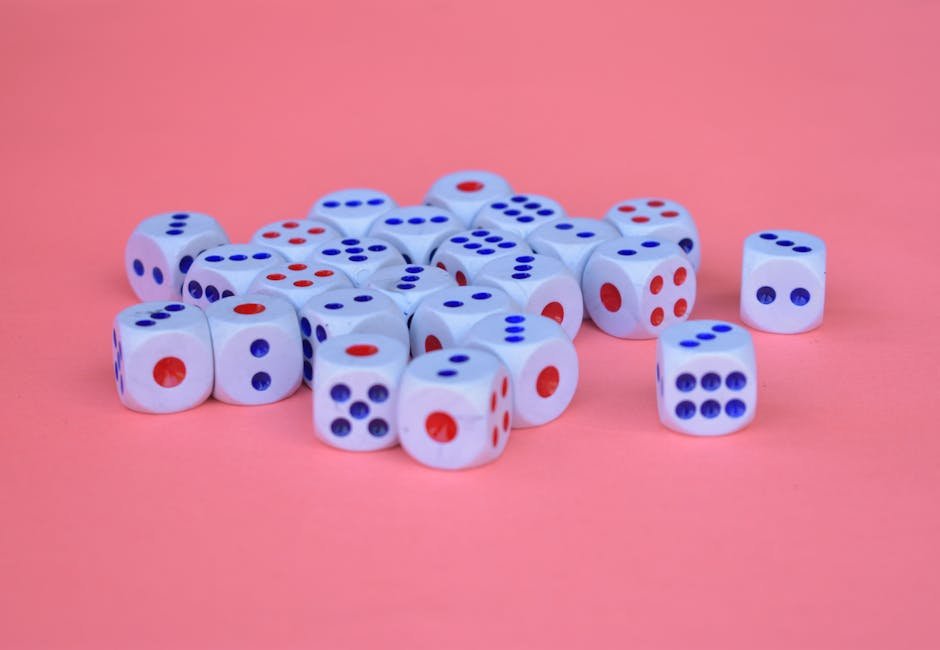
Dice are cheap, small, and already hiding in most game closets, which makes them one of the easiest ways to squeeze some multiplication into an ordinary afternoon. A round takes about as long as waiting for pasta water to boil.
Parents and teachers will find one basic game and three variations, plus some honest dice math: what a pair of dice covers well and which facts it never rolls at all.
What Two Dice Can and Cannot Roll
Two standard dice can land in 36 different ways, from a 1 and a 1 up to a 6 and a 6. Multiply each pair and you get products from 1 to 36. That sounds like a full set, but only 18 different products ever show up.
Some come up far more often than others. A product of 6 can be rolled four ways (1 and 6, 6 and 1, 2 and 3, 3 and 2), and so can 12 (2 and 6, 6 and 2, 3 and 4, 4 and 3). A product of 1, 9, 16, 25, or 36 needs a double, so each of those has only one way to appear.
Other numbers never appear at all. There is no way to roll a product of 7, 11, 14, 21, or 28, because each of those needs a factor bigger than 6. So a pair of ordinary dice practices only the facts from 1 × 1 to 6 × 6.
That matters for older kids. In states using the Common Core, students are expected to multiply any two single-digit numbers from memory by the end of 3rd grade, and many schools add the 11s and 12s. The 7s, 8s, and 9s, which many kids find harder, need a different die or a different rule. Both appear in the variations below.
One more fact worth knowing: the product comes out even on 27 of the 36 possible rolls, so three rolls out of four. An odd product needs two odd numbers. Kids who play for a while often start to notice this on their own, and it makes a good question to ask them afterward.
One Basic Game and Three Twists
The Basic Game: Roll, Say, Score
Two players or more, two dice, a pencil, and a scrap of paper for the score. Here is how a turn works.
- Roll both dice.
- Say the whole fact out loud, such as "four times five is twenty."
- Another player checks the answer, with a multiplication chart if needed.
- Add the product to your running total on the score sheet.
- Pass the dice. The first player to reach 100 wins.
Saying the full fact matters more than it looks. Shouting just "twenty" practices the answer, but saying "four times five is twenty" connects the answer to the fact, which is what has to come back later on a worksheet.
The running total is a bonus: adding 20 to 47 is mental addition practice tucked inside the game. On average a roll is worth a little over 12 points, so a game to 100 usually takes about eight to ten turns each.
Dice do not care about order, but at school 3 × 5 is read as three groups of five. If your child rolls a 3 and a 5, they can read it either way, since 3 × 5 and 5 × 3 are both 15. Pointing that out now and then is a quiet lesson in why the order of the factors does not change the product.
Variation 1: The Table of the Week
Pick the table your child is working on, say the 7s, and write it on the score sheet. Now roll only one die. The die gives the number of groups, so a roll of 4 means 4 × 7 = 28.
Write the six products of this round in a row: 7, 14, 21, 28, 35, 42. Each roll crosses one off. The first player to cross off all six wins, and repeated rolls are simply a free say-it-again. With a ten-sided die, the row grows to 9 × 7 or 10 × 7, depending on how the die is numbered.
This variation works best once the table has been introduced at school. It gives the newest facts lots of repetition without the full mix, so the 7s get attention without the easier tables crowding them out.
Variation 2: The Missing Products Hunt
Each player writes the numbers 1 to 36 on a strip of paper. Take turns rolling two dice, multiplying, and crossing off the product on your own strip. After fifteen rolls each, compare strips.
Some numbers are crossed off on everyone's strip, often 6 and 12. Others are never touched. Ask why nobody crossed off 7 or 13. Kids who hunt for two dice that make 7 find that only 1 × 7 works, and a regular die stops at 6.
This game takes a little longer and talks more than it races, which suits a child who likes puzzles better than speed. It also turns the dice facts from the first section into something kids find out for themselves.
Variation 3: Ten-Sided Dice for the Harder Facts
Game and hobby stores sell ten-sided dice, and they bring the 7s, 8s, and 9s into play. Check the faces before you start: many are numbered 0 to 9, some 1 to 10. A 0 is not a problem. It simply gives a zero fact, and 0 × 8 = 0 is worth practicing too.
Play the basic game, but raise the target. Dice numbered 1 to 10 average about 30 points a roll, so aim for 300. Dice numbered 0 to 9 average about 20, so 200 works. The rolls now include facts like 9 × 8 = 72 and 7 × 6 = 42, the ones that tend to take longest.
Keep the multiplication chart handy at first. These facts are harder, and a checker who can look them up keeps the game moving instead of turning into an argument.
Playing at Home or at a Small Table
At home, roll the dice inside a shoebox lid or a baking pan. They stay on the table, the noise drops, and nobody crawls under the couch looking for a 4. A pair of dice in a zip bag also travels well for waiting rooms and restaurants.
In a classroom, any of these games fits a math center for pairs. Foam dice keep the volume down. Give each pair one checker card per game, the products for the table they are working on, so they can settle a disagreement without calling you over.
Younger kids can join with a smaller job. A 2nd grader can add the two dice instead of multiplying them, or roll one die and count by fives that many times. Everyone plays the same game at their own level.
When the Dice Go Back in the Box
Dice are random, and that has a downside. Over a whole game, some facts come up again and again while others barely appear, so a dice game is a good extra, not a complete practice plan. Write down the facts that caused a long pause and give them a few extra minutes later in the week.
For a set that covers every fact of a table, try the mixed-order round on the 7 times table page. The second star asks every fact of that table in shuffled order and without hints, so nothing depends on luck. If board games are a hit at your house, homemade times tables board games use dice too, with a board to move along.
Related articles
- Learning Times Tables with LEGO: Build and Multiply at the Same Time
- Board Games for Times Tables: Practice That Feels Like Game Night
- Indoor Recess Multiplication Games for the Whole Class
- Family Math Games for Times Tables: Practice as a Family Activity
- 15 Multiplication Card Games You Haven't Tried Yet